Last updated: April 2026. Disney pricing changes annually — always verify current costs on the Walt Disney World website before your trip.
The Disney Dining Plan sounds simple enough — prepay for your meals, show up, eat, enjoy. But most people either overpay for it or underspend their credits, and either way they leave value on the table.
This post may contain affiliate links. As an Amazon Associate I earn from qualifying purchases. If you click and buy, I may receive a small commission at no extra cost to you. Read our Disclosure Policy
This post is for people who’ve already decided to add the plan to their trip. You’re not here to debate whether it’s worth it — you’re here to make sure you get every last dollar out of it. These Disney Dining Plan hacks will help you do exactly that.
Contents
First: Know What You’ve Actually Paid For
Before any hack makes sense, you need to know your benchmarks. Here’s what the 2026 plan costs and what counts as good value for each type of credit.
The Two Plans
Quick-Service Dining Plan — $60.47 per adult per night (children 3–9 eat free)
- 2 quick-service meal credits per person per night
- 1 snack credit per person per night
- 1 refillable resort mug
Standard Disney Dining Plan — $98.59 per adult per night (children 3–9 eat free)
- 1 table-service meal credit per person per night
- 1 quick-service meal credit per person per night
- 1 snack credit per person per night
- 1 refillable resort mug
The Value Benchmarks
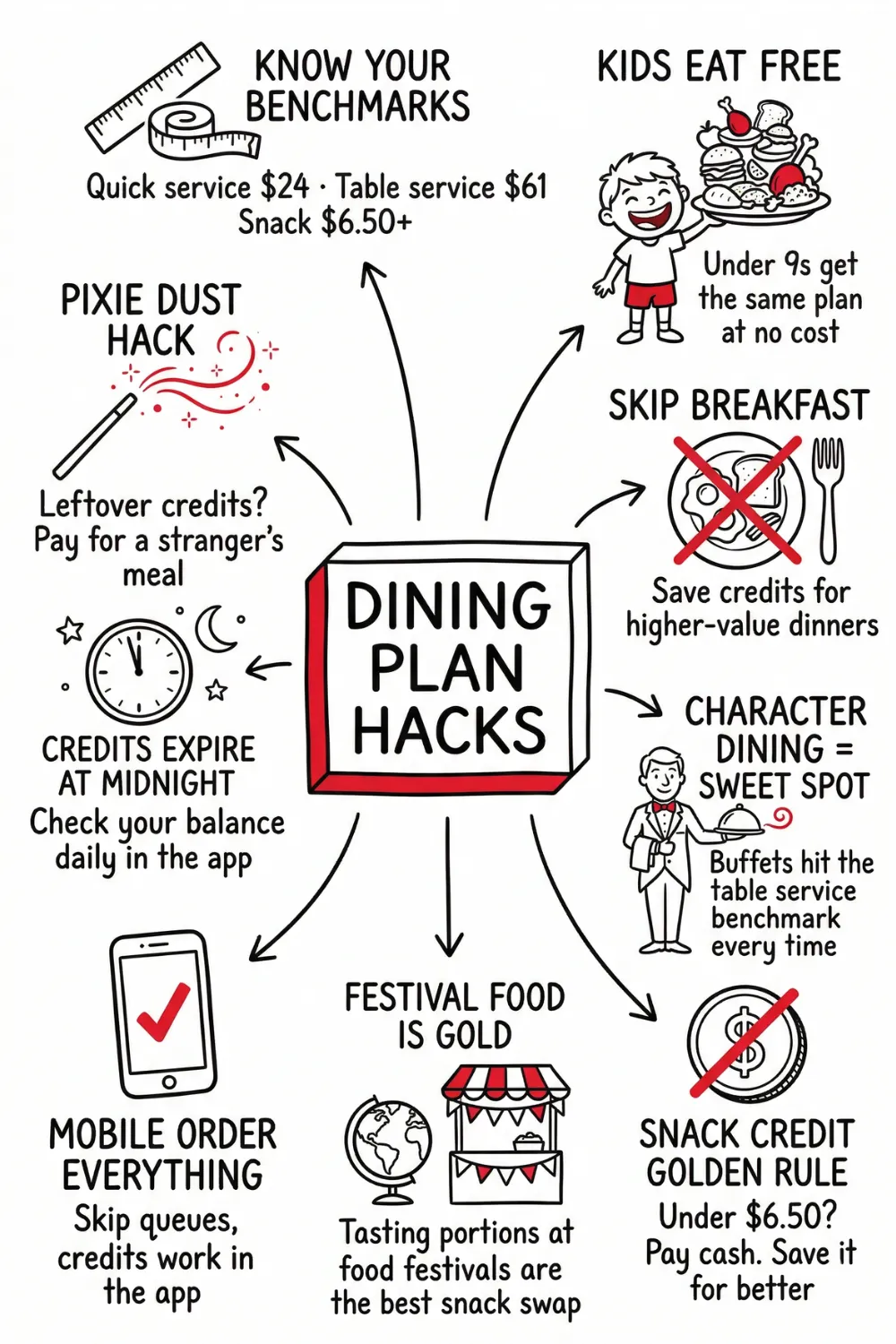
Think of these as your break-even points. If you spend less than this per credit, you’re losing value:
- Table service credit: aim for a meal that costs $61+ per adult
- Quick service credit: aim for a meal that costs $24+ per adult
- Snack credit: aim for items that cost $6.50+
The Kids Eat Free Deal — Don’t Overlook This
For 2026, children aged 3–9 receive the same dining plan as the adults in the booking completely free. On a 5-night trip, a family of two adults and two children on the Standard Plan pays around $985 versus roughly $1,470 paying out of pocket. That gap is almost entirely driven by the kids eating free. If you have young children, this changes the maths significantly in your favour.
Two More Things to Know Before You Eat
Credits are pooled. All credits for your entire party are combined into one pot and available from the moment you check in — even before your room is ready. Any member of your party can use any credit. You don’t need to match one credit per person per meal (except at buffets and all-you-can-eat restaurants, where everyone at the table must use a credit).
Credits expire at midnight on checkout day. Plan your big meals for earlier in the trip and keep an eye on your running balance in the My Disney Experience app so you’re not scrambling on the last day.
Table Service Hacks
Table service credits are your highest-value credits — and the easiest ones to waste if you’re not paying attention.
Skip Breakfast, Save Credits for Dinner
Breakfast is almost always the worst use of a table service credit. Disney breakfast menus are typically cheaper than lunch and dinner, which means your ~$61 credit is working harder than it needs to. Pay out of pocket for breakfast — a pastry and coffee from a resort food court costs a fraction of what you’ll save by reserving that credit for dinner.
Character Dining is the Sweet Spot
Character dining buffets like Chef Mickey’s, Crystal Palace, Tusker House, and Garden Grill regularly cost $60–$70+ per adult out of pocket — which means they sit right at or above the table service benchmark. You get a full buffet, unlimited food, and character meet-and-greets built into the meal. It’s the closest thing to a guaranteed win the dining plan offers.
Dinner at a character restaurant is generally better value than breakfast or lunch — the food is more substantial and the out-of-pocket price is higher, so your credit goes further.
The Kids’ Free Credit Hack
This is one of the most underrated moves on the plan. Your children aged 3–9 are eating for free, which means their credits are essentially bonus credits. Use those credits at high-value character buffets where the out-of-pocket cost for a child would be $40–$60. You’re getting real dollar value from a credit that cost you nothing.
Think Carefully Before Using Two Credits
Several restaurants require two table service credits per person: Cinderella’s Royal Table, Princess Storybook Dining at Akershus Royal Banquet Hall, and Story Book Dining at Artist Point with Snow White. These meals are expensive — but they’re not twice as expensive as a standard table service meal, which means you’re rarely getting double the value from two credits. Unless the experience itself is the priority (and for some families it absolutely is), one-credit character dining delivers better financial value.
Tips Are Not Included — Budget for Them
This catches a lot of people off guard. Gratuity is not included in the dining plan for standard table service restaurants. Budget an extra 18–20% on top of your meal for tip. The exceptions are Cinderella’s Royal Table, Disney dinner shows, and in-room dining — gratuity is included at those venues.
Overflow Trick: TS Credits at QS Locations
If you run out of quick service credits, you can use a table service credit at a quick service location instead. It’s not ideal value but it’s useful to know if your credit balance is looking lopsided near the end of your trip.
Quick Service Hacks
Don’t Use QS Credits for Breakfast
Same logic as table service — QS breakfast options are cheaper than lunch and dinner, so your ~$24 credit is doing less work. Grab a snack credit item for breakfast (more on that below) or pay out of pocket, and save your QS credits for bigger meals.
Best Value Quick Service Locations
Not all QS restaurants are equal. These locations consistently offer meals that hit or beat the $24 benchmark:
- Flame Tree Barbecue (Animal Kingdom) — large platters, $17–19, portions are generous enough to share
- Satu’li Canteen (Animal Kingdom — Pandora) — customisable bowls, $17+, filling and delicious
- Docking Bay 7 (Hollywood Studios — Galaxy’s Edge) — themed and substantial, ~$17
- Sunshine Seasons (EPCOT) — excellent variety, Asian noodle combos and rotisserie chicken regularly exceed the benchmark
- Columbia Harbour House (Magic Kingdom) — the lobster roll at ~$15 is one of the best QS values in the park
Share Meals to Stretch Credits
QS portion sizes at Disney are generous. If you’re not ravenous, splitting an entree between two people and supplementing with a snack credit is a smart way to make your credits go further — especially for lighter eaters or younger children.
Ask for a Smoothie or Shake Instead of a Soda
Most quick service locations allow you to swap your included drink for a smoothie or milkshake at no extra charge. Always ask. A soda is worth next to nothing; a fresh smoothie or shake is a meaningful upgrade.
Order Ahead on My Disney Experience
Mobile ordering through the My Disney Experience app works with dining plan credits and it’s the single best way to save time at busy QS restaurants. You place your order from anywhere in the park, pay with your credits, and head to the restaurant when it’s ready. No queue, no waiting, no stress.
Locations with No Kids’ Menu Are Your Friend
At most QS restaurants, children on a child dining plan can only order from the children’s menu — which tends to be cheaper items like nuggets and hot dogs. But at locations with no separate kids’ menu (Casey’s Corner, Yorkshire County Fish Shop, Sommerfest), children can order from the adult menu, which improves the value of their credits considerably.
Snack Credit Hacks
Snack credits are the most underestimated part of the dining plan — and the most wasted. Here’s how to use them well.
The $6.50 Rule
If an item costs less than $6.50, pay cash and save the snack credit for something better. A bottle of water or a banana technically qualifies as a snack credit item, but using a $6.50 credit on a $3 banana is how you lose value fast. Pay out of pocket for anything cheap.
EPCOT Festival Booths Are the Holy Grail
If your trip overlaps with the EPCOT Food & Wine Festival or Flower & Garden Festival, prioritise using snack credits there. Festival booth tasting portions run $7–$10 and are some of the most interesting food in any Disney park. Using snack credits at festival booths is one of the best swaps on the entire plan.
Specialty Coffee Counts
Joffrey’s and Starbucks specialty drinks — lattes, Frappuccinos, cold brews — qualify as snack credits at Disney locations. A specialty coffee that would cost you $7–$8 out of pocket is a much better use of a snack credit than a standard soda or piece of fruit.
Use Snack Credits for Breakfast
There are plenty of snack-eligible items that make a perfectly good light breakfast — pastries, fruit cups, yoghurt parfaits, Mickey waffles to go. Using a snack credit for breakfast frees up your QS credit for a more substantial midday or evening meal, which is almost always worth more.
The 2024 Rule Change: Credit Conversion is Gone
This is important if you’ve read older versions of this advice anywhere online. Before 2020, you could convert one quick service credit into three snack credits. That is no longer possible. Since the plan relaunched in 2024, snack credits and meal credits must be used for their intended purpose. There is one limited exception at L’Artisan des Glaces in EPCOT, but don’t rely on it as a strategy.
Don’t Let Credits Expire — Use Them on Snacks to Take Home
In the last day or two of your trip, check your balance in the My Disney Experience app. If you have snack credits left, use them on packaged items — chocolates, popcorn, candy, character-themed snacks — that you can take home as souvenirs or eat on the journey back. It’s a much better outcome than letting them expire at midnight on checkout day.
The Pixie Dust Hack
If you genuinely have credits left at the end of your trip that you can’t use, here’s a more magical option: use them to pay for the meal of a stranger sitting next to you at a counter service restaurant or at a nearby table. It’s a Disney tradition with a long history and one of the nicest things you can do with a leftover credit.
Planning Hacks That Save You Time and Stress
Book Dining Reservations Before You Arrive
The dining plan reserves your credits — it doesn’t reserve your table. Popular table service restaurants book up 60 days in advance, and if you don’t have a reservation you may not be able to use your TS credits at the restaurant you actually want. Log into My Disney Experience as soon as your booking window opens and secure your key dining reservations before your trip.
Track Your Balance in Real Time
The My Disney Experience app shows your running credit balance throughout your trip. Check it regularly — it’s the simplest way to avoid the end-of-trip panic of realising you’ve over or under-spent in one category.
Don’t Try to Break Even Every Day
Because credits are pooled across your entire stay, you don’t need to use one of each credit type every single day. Some days you might use two QS credits; others you might not use any. Plan your big table service meals around the restaurants you actually want to eat at, not around hitting a daily quota.
Pay Out of Pocket for Cheap or Small Meals
If someone in your party just wants a small snack or a cheap meal, pay cash. Spending a QS credit on a $10 kids’ meal when that credit is worth $24 is exactly the kind of low-key waste that adds up across a whole trip.
The Refillable Mug — Actually Use It
Your plan includes a refillable resort mug for unlimited fountain drinks, coffee, tea, and hot chocolate at your Disney Resort hotel. If you’re spending time at the resort (pool days, early mornings, evenings back from the parks) make sure you’re actually using it. It’s a small thing but it’s included and people forget about it.
Quick Reference: Disney Dining Plan Hacks Cheat Sheet
| Hack | Why it works |
|---|---|
| Skip breakfast with TS and QS credits | Breakfast menus are cheaper — save credits for dinner |
| Use TS credits at character dining buffets | $60–$70+ out of pocket = over the $61 benchmark |
| Use kids’ free credits at high-value restaurants | Bonus credits that cost you nothing |
| Avoid two-credit signature restaurants | Rarely double the value of a one-credit meal |
| Swap soda for a smoothie or shake | Better value, no extra charge at most QS locations |
| Use snack credits at EPCOT festival booths | $7–$10 tasting portions = best snack credit use |
| Use snack credits for specialty coffee | $7–$8 Starbucks or Joffrey’s drinks qualify |
| Mobile order via My Disney Experience | Skip queues, credits work through the app |
| Track balance daily in the app | Avoid end-of-trip credit crunch |
| Use leftover snack credits on packaged goods | Take Disney snacks home instead of letting credits expire |
Whether you’re a Disney first-timer or a seasoned park veteran, the dining plan rewards people who think ahead. Know your benchmarks, book your table service restaurants early, and prioritise the meals and snacks that actually beat the credit value — and you’ll come home feeling like you got a great deal.
For more help planning your Disney trip, check out our Disney vacation packing list and our tips on Disney dining plan snack credit mistakes to make sure you’re not leaving any value behind.